Sorority Recruitment Conversation Tips for Recruiters
Sorority recruitment is a lot of conversations in a short window, and after a while, every conversation starts to blur together. As a recruiter, you're meeting dozens of PNMs in a short window, and you're doing two things at once: learning enough about someone to consider what kind of member they'd be, and giving them reasons to rank your chapter first (while you also remember her name and fight flagging energy halfway through the day).
Updated June 23, 2026
From our Sorority Recruitment Guide
That balance is the whole game. Recruitment conversations aren't job interviews, but they're not just friendly chat, either. You want to come away knowing who someone is so you can evaluate them thoughtfully and fairly, not just based on their banter. And at the same time, a PNM should leave your conversation feeling like she connected with someone in the chapter, not like she was auditioning.
These tips will help you move past surface-level small talk, ask questions that reveal something, share your chapter in a way that feels real, and have genuine conversations.
Know What You're Trying to Learn
Before you walk into a round, get clear on what you're paying attention to. "Good conversation" isn't enough. You want to get a sense of someone's leadership, initiative, resilience, empathy, or follow-through, so that your assessment is grounded in something specific, not just chemistry (or a shared love of matcha tea lattes).
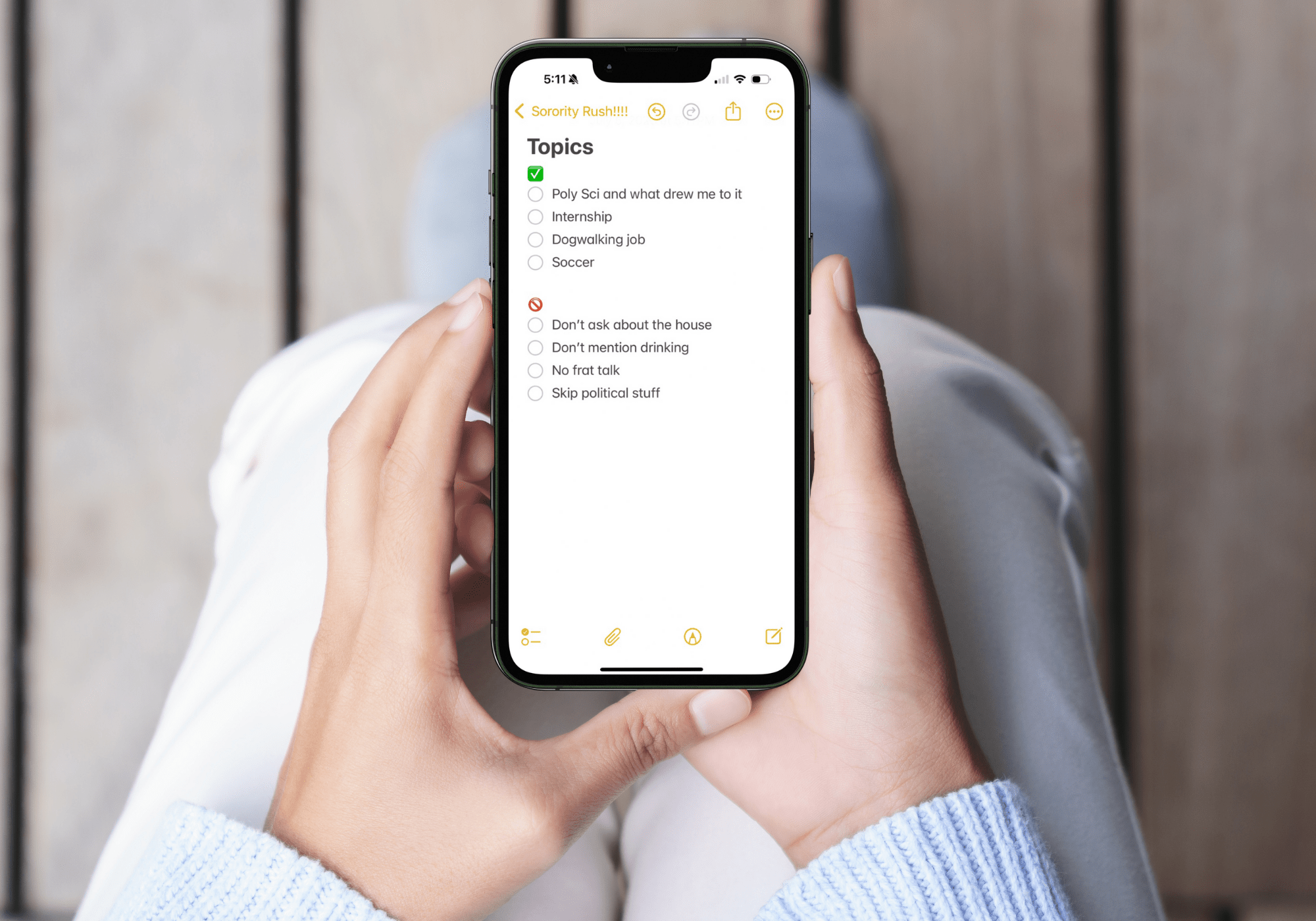
That doesn't mean grilling a PNM on her resume. It means listening when she tells you about her summer job or her club soccer team to see what the story says about her. And if the story doesn't reveal much, asking follow-up questions that could get you somewhere meaningful.
It also means knowing what you want a PNM to take away about your chapter. If your philanthropy just hit a fundraising record, or your sisterhood retreat last semester was the highlight of the year, those are stories you should be ready to share. The best conversations go both directions.
The recruiters who do this well aren't winging it or working from a script. They know what they're listening for and what they want to share, so they can stay relaxed and responsive instead of running through a mental checklist.
Ask Questions That Make Them Think
When you meet anyone for the first time, you default to the basics: where are you from, what's your major, what dorm are you in. It's how people find common ground. But when you only have 10 minutes with a PNM, those questions will eat up all of your time. You'll burn through half your time and walk away with facts you could have pulled from a recruitment registration form.
Stronger questions ask a PNM to reflect, not recite. They should need a second to think before answering. That pause is a good sign; it means you're getting something real.
Some questions that do this well:
"What's something you almost quit but didn't?": tells you how someone handles hard things.
"What's something you took on that wasn't your job?": shows initiative without a title, which is one of the clearest signs of leadership.
"What's the last thing you did for someone who didn't ask for it?": gets at how they treat the people around them.
These don't feel like interview questions, and the answers will tell you more about character, resilience, and leadership than swapping hometowns ever could. You'll get better answers than "I'm from Dallas and I love Pilates."
A good test: try answering your own go-to questions. If your answer is the kind of thing you'd jot down after a round, it's a strong question. If it's forgettable, swap it out.
Layer Your Follow-Ups
A good opening question gets someone talking. It's your job to do something with the answer.
If a PNM tells you she's captain of the lacrosse team, that's a starting point, but "plays lacrosse" doesn't tell you much on its own. Work from there. Ask what she learned as captain. Ask what surprised her most about leading other people. Ask what she'd do differently if she were starting over.
That's how you move from a surface fact to actual insight: "leads under pressure," "takes responsibility," "grows from mistakes." One good follow-up can turn a forgettable answer into something you'll remember when you're comparing notes with other members.
The key is making follow-ups feel like conversation, not interrogation. The easiest way to do that is to build on something a PNM has already shared instead of switching topics cold. If she says "my Spanish teacher was a huge influence on me," ask what that teacher did that stuck with her. If she talks about organizing her a cappella group's spring showcase, ask how she pulled it together. If she brings up her volleyball team or student government, ask what it's like working with that many different personalities.
These questions land naturally because they follow from her own story. They don't come out of nowhere, and they don't feel like a pop quiz. But they surface independent thinking, agility, and conviction: qualities that are hard to spot with standard-issue questions.
Follow-ups are also where the conversation can become a two-way street. If a PNM mentions organizing a fundraiser for Key Club, that's a natural opening to share how your chapter raised money for St. Jude last spring. Now you're learning about her and giving her a window into what your chapter does.
Reflect Before You Redirect
It's easy for recruitment conversations to move fast: a PNM shares something meaningful, and the recruiter jumps straight to their own experience or the next question. The PNM doesn't feel heard.
A better move is to pause and respond to what they said before adding anything new. The formula: their words, followed by a question that stays on that topic for another beat.
If a PNM says she's studying biochem, don't immediately pivot to your own major. Try: "Biochem sounds intense, what drew you to it?" If she mentions missing her dog, don't jump to yours: "It sounds like you miss your dog, what kind do you have?" If she asks about big/little, tell her how much you love having twins, then ask what she's most looking forward to about having a big.
It's a small shift, but practicing it before recruitment starts makes a difference. When a PNM feels heard, she opens up, gives you a better picture of who she is, and you'll have a conversation both of you will remember.
You can still share your own experiences. Just keep it brief, frame it as a parallel, and hand the conversation back. "I love event planning too, I helped organize our philanthropy auction last semester and it was one of my favorite things I've done." Then stop before the conversation shifts to being about you. Ask another question or let them ask a follow-up if they want to.
Share Your Chapter Like You Mean It
The best recruiters don't pitch their chapter, they share it. A pitch hits HQ's talking points. Sharing means telling a PNM how your chapter's values show up in your life: a moment that surprised you, a time you felt like you belonged, a story you'd tell a friend.
Think about specific moments. Any recruiter can say "we have great sisterhood events," but "We did a sunrise hike last semester and I honestly didn't want to go, but it ended up being one of my favorite mornings all year" is something only you can say. Same idea with philanthropy. Instead of "it's important to us," talk about what it felt like to hit your fundraising goal or what you saw at a volunteer event that stuck with you.
Details are what makes things hit home. A PNM has heard "our sisterhood is strong" from every chapter she's visited. She hasn't heard the story about the time six members drove four hours to watch your debate tournament. You can't help but share that story with feeling and it will show.
Timing matters too. Don't open with a hard sell in the first two minutes. Bring up your chapter's best qualities in response to something the PNM said, as a parallel to an experience she shared, or as a bridge when you're shifting topics. When it flows out of the conversation instead of interrupting it, it feels authentic because it is.
A PNM is forming an opinion about your chapter at the same time you're forming one about her. Every specific, genuine thing you share helps her picture what it would be like to be a member, and that's what makes her want to rank your chapter first.
Use Their Name
An easy win: when you use a PNM's name once or twice during the conversation, naturally, not every sentence, it creates a subtle sense of connection. In a day full of back-to-back parties, that kind of detail makes someone feel special.
Something like "That's a great point, Maya" or "I didn't know that, Jordan" is enough.
And if you forget their name, it happens, especially late in the day. Just ask. "I'm sorry, can you remind me of your name?" That's not awkward. It signals that you care enough to get it right, and it resets the conversation in a good way.
Listen for What Matters
When a PNM starts talking, you're not just collecting facts; you're picking up on what matters to them and how they live.
Things to listen for:
- Leadership that doesn't show up on a resume
- Empathy and genuine care for the people around them
- Growth moments where they overcame something or changed their mind
- Taking responsibility instead of shifting blame
- Grit, follow-through, or a strong work ethic
- Learning from mistakes rather than glossing over them
- Resilience after a setback
These qualities tend to come out in stories, not in lists of accomplishments. If a PNM is telling you a story, let it play out. The details can matter more than the headline.
Read the Room
Body language and tone can tell you as much as what someone says. Pay attention to whether a PNM lights up when talking about certain topics, gets thoughtful when reflecting on a question, or tends to dominate the conversation without leaving space.
These cues help you read someone's personality and how they might fit in your chapter, and they also tell you when to shift gears. If a PNM seems nervous or withdrawn, that's your signal to ease up and try a different angle, not to push harder.
It goes both ways. If you're glancing around the room or leaning away, she'll notice. Eye contact, open posture, and facing her signal that you're interested in what she has to say.
When the Conversation Stalls
Some PNMs will be nervous, exhausted, or just quieter by nature. If you're getting one-word answers or the conversation feels stuck, don't panic. And don't fill the silence by talking more about yourself.
Try shifting to something low-stakes and specific. Ask about pets, favorite shows, a trip they took, or something they did over the summer. Most people relax when the question doesn't require a "correct" answer.
Pets in particular tend to unlock something. If a PNM has a dog at home, you'll almost always get a real reaction or a funny story. Even if they don't have a pet, the question should get the conversation moving again.
You can also share something about yourself or the chapter to take the pressure off. A quick story about a funny thing that happened at your last chapter event, or a tradition you didn't expect to love, shifts the energy and gives her something to react to instead of another question to answer.
And if a PNM freezes mid-sentence or loses her train of thought, don't make it a thing. Give her a beat, then help her back in with something specific: "You were telling me about [topic], I wanted to hear more about that." It gives her a graceful re-entry and shows you were paying attention.
When you move past predictable questions and engage with what a PNM shares, two things happen: they feel comfortable enough to be themselves, and you walk away with the kind of information that helps your chapter make thoughtful decisions.
And when you share your own chapter experience with the same energy (specific, genuine, personal), a PNM walks away feeling what it would be like to be a member. Not because you sold them on it, but because you showed them what it's like.
The best recruitment conversations happen when you're curious, you listen more than you talk, and you're willing to follow a conversation where it goes instead of steering it back to a script. Your whole chapter can practice these approaches during work week and level up your recruiting skills.
Great conversations are just one part of running a strong recruitment. For more on how the process works, check out our Sorority Recruitment Guide.
More sorority advice:
→ 87 Sorority Acronyms Explained
→ How is Quota different from Campus Total?
→ What Is RFM, Anyway??
And follow @maziandzo on TikTok for real talk about recruitment and sorority life.